
How Bid Reviewers Interpret Document Quality and Mistakes in High-Stakes Submissions
In competitive, high-stakes bidding environments, proposals and procurement documents are rarely judged solely on their content.
They are evaluated under time pressure, compared side by side with competing submissions, and read by people with no context beyond what appears on the page. In those conditions, document quality does more than communicate information. It sends signals.
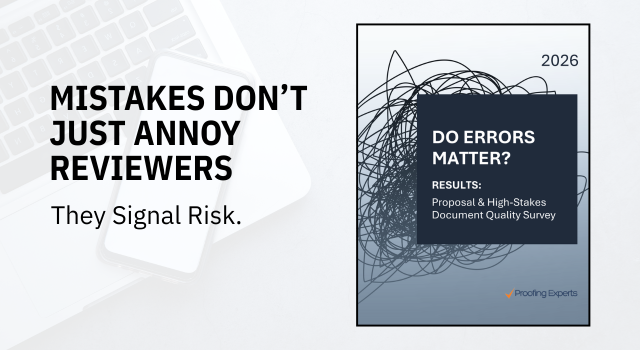
This question sits at the heart of “Do Errors Matter? The 2026 Proposal & High-Stakes Document Quality Survey” conducted by Proofing Experts.
In competitive procurement, perception forms before evaluation.
Do mistakes, errors and typos matter?
The short answer is yes, but not in the way many teams assume.
A single typo rarely kills a submission, but repeated quality issues quietly erode trust.
An error or two rarely disqualify a submission outright. Most proposals are not set aside because of a single typo or isolated clarity issue.
Instead, reviewers describe a more subtle experience. Something does not feel credible.
Survey respondents consistently reported encountering recurring issues such as lack of clarity, inconsistent formatting, overly dense or poorly structured content and avoidable errors and typos.
When these issues recur in a document, they create hesitation, even if no individual issue is severe enough to justify rejection on its own. This hesitation is real, influential and often decisive.
Document quality functions as a credibility signal
More than 60 percent of survey respondents reported difficulty trusting a vendor or moving forward because of how a submission was presented.
In effect, document quality functions as a credibility signal. When quality issues accumulate, reviewers begin to draw conclusions about a team’s control, discipline and competence.
As one respondent put it:
“One goof? Not huge, but noticed. Many? You’re done.”
How professional judgment is absorbed, not articulated
The survey shows that more than 90 percent of respondents have experienced or observed hesitation based on writing or presentation quality.
What the survey does not directly measure is how, or whether, those concerns are communicated back to the document authors.
Based on Proofing Experts’ field experience working with proposal teams and procurement stakeholders, these judgments are rarely made explicit in feedback. Reviewer comments tend to remain high level and non-confrontational and are expressed in terms of overall fit, confidence in the vendor or perceived risk.
As a result, teams producing proposals often never learn that document quality contributed to a lost opportunity.
Familiarity hides problems from authors
Nearly half of the survey respondents reported that they both create and evaluate high-stakes documents. This dual role highlights an important asymmetry.
Authors read with context. Evaluators read cold.
Authors with deep knowledge of the product or service naturally fill in gaps, resolve ambiguities and smooth over inconsistencies when reviewing their own work. They know what the document is meant to say.
Evaluators do not have that advantage. They rely entirely on what is written, structured and surfaced on the page.
This gap helps explain why teams are often surprised by negative outcomes and why internal reviews alone may fail to catch issues that external readers notice immediately.
Quality issues accumulate under pressure and signal risk
Respondents were clear that quality problems are not inevitable. Across open-ended responses, participants emphasized the value of clear, upfront summaries, disciplined time for review and proofreading, fact-checking, final consistency checks, and the reuse of approved, consistent content blocks.
While the survey does not ask respondents to attribute root causes, Proofing Experts’ interpretation, informed by long-term field experience, is that recurring quality issues often arise under compressed timelines, fragmented ownership and insufficient review discipline.
From a procurement perspective, however, the cause matters less than the signal. Repeated quality issues were interpreted as a risk.
As one respondent noted:
“Proof, proof and more proofing. Allow time in the response to deliver that includes time to fact check and have an airtight document.”
What this means for teams producing high-stakes documents
Taken together, the findings point to a consistent pattern.
- Reviewers notice document quality quickly.
- Conclusions are formed even when they are not articulated.
- Those conclusions influence trust, confidence and award decisions.
When the stakes are high, document quality is not cosmetic. It is a competitive signal.
Teams that treat clarity, consistency and correctness as integral rather than optional reduce their risk of being quietly set aside and improve how their work is perceived before technical merits are even weighed.
About the survey
“Do Errors Matter? The 2026 Proposal & High-Stakes Document Quality Survey” is based on responses from 89 professionals involved in creating, reviewing or evaluating proposals and procurement materials.
The research was conducted by Proofing Experts to show the patterns that shape decision-making and contract awards in competitive, document-driven environments.